This article was prepared with support from the Berlin Senate Department for Culture and Social Cohesion.
Agreement Is More Interesting Than Unity
For more than 30 years, Germany has celebrated German Unity Day on 3 October. But what does this date actually mean to the people who live in the country? What significance does it have today for those who experienced the political upheaval of 1989 and for those who came to Germany later?
A celebration in Berlin offered a different perspective on this day. Instead of focusing on formal speeches by politicians, the event centred on personal stories, different viewpoints and questions that concern us all.
Agreement is more interesting than unity. At first glance, this may sound contradictory. After all, 3 October symbolises the reunification of Germany. Yet unity does not mean that everyone must think alike. Genuine agreement emerges when people with different experiences can listen to one another, disagree and seek common solutions.
Personal Stories Instead of Ready-Made Answers
Participants shared their personal experiences and spoke about belonging, the feeling of being at home, and the meaning of unity and agreement in everyday life.
For some, 3 October brings back memories of historical changes that transformed their lives. For others, the date is connected to the history of a country they moved to and where they are now building their future.
Conversations like these show that a shared identity does not emerge on its own. It develops through encounters, mutual interest and a willingness to accept different experiences.
When Individual Experiences Become Shared Experiences
The stories of people who grew up in different countries and cultural environments help us see familiar events from another angle. What seems obvious to one person may be unfamiliar to another or carry an entirely different meaning.
This is precisely the value of dialogue: not that everyone reaches the same conclusions, but that people come to understand one another better.
This is particularly important in a society where people have different backgrounds, religions and life experiences. Rather than reducing someone to their origins or beliefs, we should give them the opportunity to tell their own story.
Social Cohesion Through Diversity
Unity does not mean uniformity. On the contrary, society becomes stronger when different voices can be heard and differences are not used as grounds for exclusion.
This also applies to people with migration backgrounds, who often face prejudice and blanket suspicion regarding their religion. At the same time, their stories, knowledge and experiences can enrich society.
We agree that unity thrives on diversity. This idea does not deny differences; instead, it emphasises the need to create spaces where people can meet as equals.
When Walls Fall, We Should Not Build New Ones
German history reminds us that walls can divide not only cities and countries, but also people. The fall of the Berlin Wall became a symbol of overcoming division. Yet even when physical walls disappear, barriers can remain in people's minds—based on origin, religion, language or social status.
It is therefore important not to allow new walls to rise in place of old ones. This requires not only political decisions, but also everyday efforts: conversations, encounters and a willingness to see another person not as a representative of a particular group, but as an individual.
We Want More
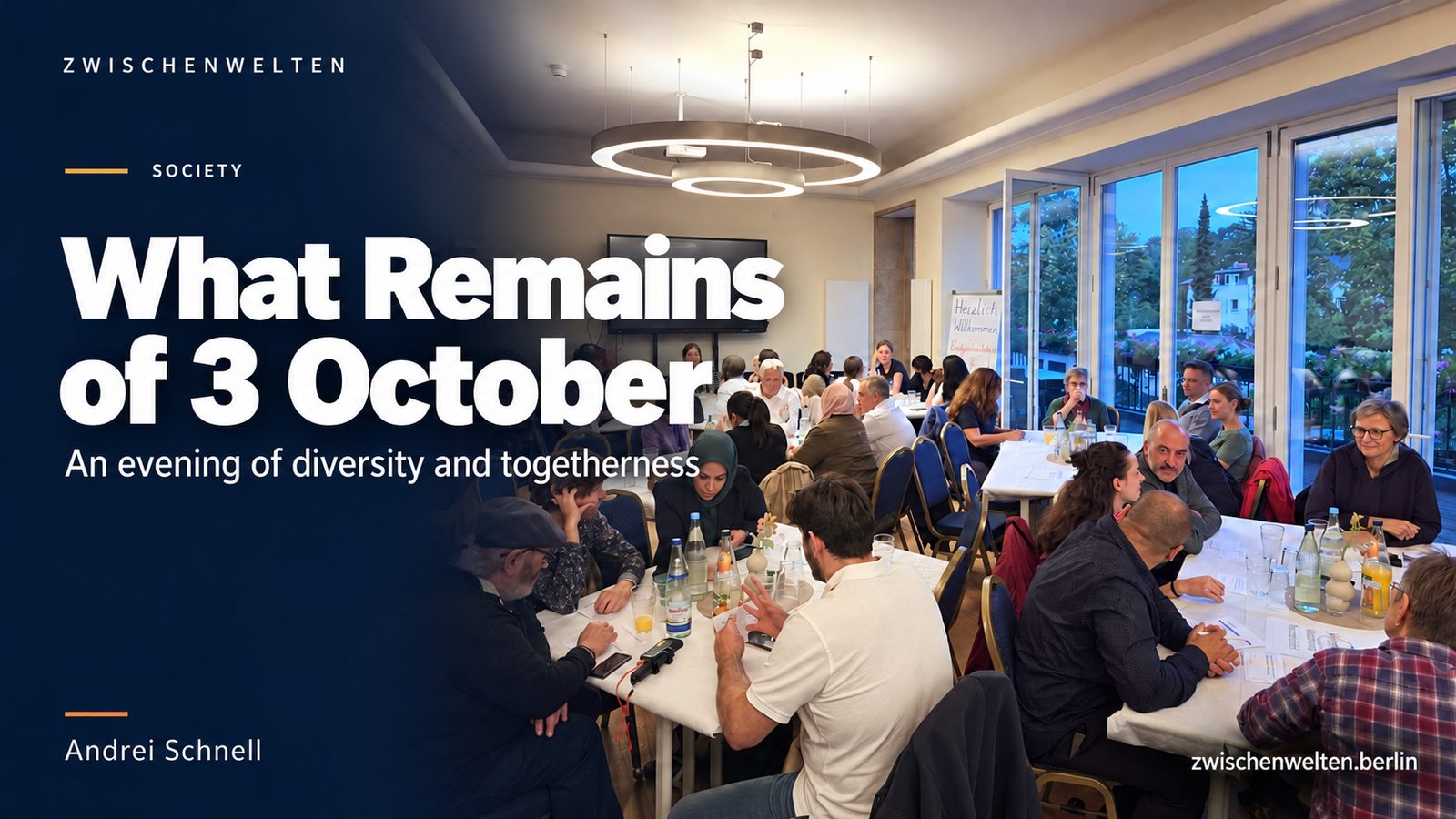
The event demonstrated how valuable encounters can be when people with different experiences communicate as equals. Participants had the opportunity to share their thoughts, ask questions and hear stories they had not encountered before.
The feedback board allowed people to leave their impressions and suggestions. The feedback was uniformly positive. Many participants expressed the wish for more events of this kind.
Such events do not provide ready-made answers to complex social questions. Instead, they create space for different viewpoints and help us recognise that a shared future begins with a willingness to listen to one another.
More Than a Date on the Calendar
3 October is more than a public holiday. It is an opportunity to reflect on what brings people together and what, by contrast, drives them apart.
Unity cannot simply be declared. It requires trust, mutual respect and a willingness to accept differences. Agreement does not mean the absence of disagreement; it means being able to remain in dialogue even when opinions differ.
Perhaps this is the most important lesson of 3 October: society becomes stronger not when everyone is the same, but when people who are different find a way to live together.
After the thematic discussion tables, the evening was far from over. Guests continued eating and celebrating together over a generous buffet. Many conversations carried on. People sat down at one another’s tables and got to know each other.
It was a celebration with music, held in a beautiful hall. But it was also an occasion for reflection on unity and agreement, on community, civic spirit and cohesion in diversity.
Celebrating 3 October for the First Time
“I’ve never really given much thought to 3 October” was a remark heard several times at the civic celebration. Some guests said they had never celebrated German Unity Day before. That evening, things were different.
Compared with national holidays in other countries, German Unity Day tends to be marked in a more understated way. The day was established to celebrate the end of Germany’s post-war division. But who celebrates this event today? Who still celebrates it? In other countries, public festivities are a much more natural part of national holidays. In Germany, for many people, Unity Day is primarily a day off.
That evening showed that a national holiday can be experienced differently. A spark can even jump across. The uniformly positive feedback on the feedback board highlighted how the opportunity to connect with other people was what turned the day into a true celebration.
“Unity Thrives on Diversity”
The feedback board also showed how the guests felt about the evening. Among the thoughts they left were the following:
Thank you for bringing us together at one table, in all our colourful diversity, on German Unity Day. :)
Thank you! By far the most wonderful German Unity Day celebration of my life. A great idea, and I met some truly lovely people.
All three speeches were exceptionally powerful and provided a great introduction to the event. The conversations at the tables were interesting; our table, in particular, really didn’t need a facilitator.
We agree that unity thrives on diversity.
More of This, Please
After the evening, many guests wanted one thing above all: more events like this. The format brought together people who had not known one another before and who quickly struck up conversations. Many guests were residents of Wedding who had never met before. Some expressed the wish for a follow-up event next year, ideally in Wedding or even in the Brunnenviertel neighbourhood.
The organisers hope that conversations between different groups will continue in everyday life, too. Perhaps that is an illusion; perhaps a hope.
Disclosure: The author, Andrei Schnell, was involved in organising the civic celebration and moderated the event. Brunnenviertel e.V., for which he volunteers, was one of the organisers.
original text: